
One free live hour: every year-end move sorted by its real deadline, plus what the Nov 5 federal budget did and didn't change.

 With Ben Corriveau + Greg Rozdeba · ~45 min + live Q&A
Twenty-item December checklists. No dates. Decisions made by default. And last year's headlines are stale — four things changed:
You're going to learn which year-end moves actually die on December 31 — and which only follow your own fiscal year-end.
You'll also see the one December sequencing mistake that permanently shrinks what your corporation can pay you without tax.
And you'll find out which of the four things you'll be told to do before year-end are real — and which two aren't.
Then the plan for what you keep: where the money that stays in your corporation can go — including how corporate-owned life insurance works, and who it isn't for.
You leave with yours filled in. Most year-end content blurs the dates to keep you nervous — we do the opposite.
A calendar date. No extensions.
Follows your corporation's year-end — which may not be December.
Has runway. Don't burn December on it.
Invented. December pressure sells.
Box ④ includes a pitch from our own industry. We strike it off the list ourselves.
The corporate advisor who hosts our business-owner sessions, and the co-founder who built the practice around one question.
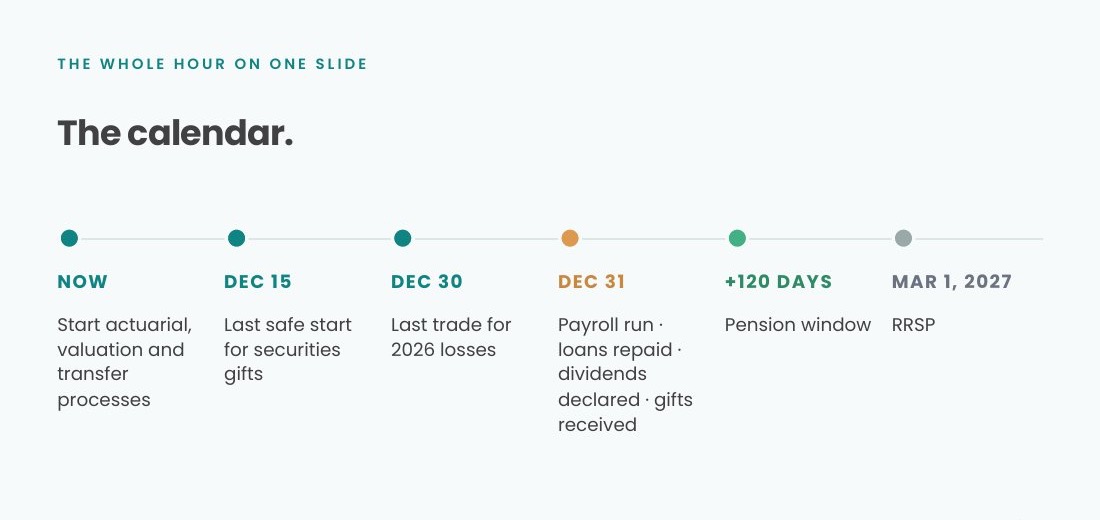
December 31 is a statutory date, not a marketing device. Some of these moves don't prorate — on Dec 31 they're all or nothing. And transfer agents, actuaries and underwriters all run year-end queues. That part isn't us; it's the calendar.
The only thing offered on the webinar is a free 30-minute session with Ben. Stay to the end for the Year-End Action Plan invitation: your moves sorted live on your own numbers, plus the deadline checklist.
Register Free for Nov 18Wed November 18, 2026 · · Zoom · Free
Live only. The recording goes to the people who were in the room.
Yes — that's exactly what Box ② is for. Your personal return always runs on the calendar year, so Box ① applies to you regardless. Box ② follows your corporation's own year-end — and if that's already passed or is coming sooner than December, your deadline may be closer than you think. We ask in the chat at the start and adapt the hour to the room.
Nothing is sold on the webinar. After the deadlines, we show where the money that stays in your corporation can go, including corporate-owned life insurance and who it isn't for. "Buy life insurance before Dec 31" is one of the fake deadlines we strike: there is no December deadline for it. We charge no fee for the session. If a plan involves a life insurance policy, the insurer pays us a commission built into the policy.
Register anyway and we'll tell you about the next session. This one is live only: the recording goes to the people who were in the room.
No — it's built to feed them. Your accountant files what happened; December is when you decide what happens. Everything we sort is meant to go straight to your CPA — the Year-End Deadline Checklist is built to hand to them, and if the tax side needs a closer look than a 30-minute call can give it, Ben introduces you to a CPA partner rather than guessing.
For: incorporated Canadian business owners with retained earnings in the corporation. Not for you if you're not incorporated, there's no retained cash to make decisions about, or your CPA has already run this list with you (then you're set — genuinely).
RRSP contributions run to March 1, 2027. Pension funding runs 120 days past your corporate year-end. The two dates that don't wait: securities gifts need to start by about December 15 to reach the charity in time, and a loss sale has to settle in 2026 — last trade date is Wednesday, December 30.